
Rusty’s Hawaiian
Ka‘u District, HI
“[Working and being a woman in agriculture] means joining a group of determined women around the world. According to the International Coffee Organization, women own only 20 to 30 percent of coffee farms globally. I’m proud to be one of them.“
Q: Tell us about your agricultural operation, your background and how you got started in agriculture.
My late husband, Rusty Obra, started Rusty’s Hawaiian — our farm, mill and roastery — as an early-retirement project in 1999. At the time, Ka‘u was known for abandoned sugarcane plantations, and the former sugar-mill workers had recently started transforming the fields into family-owned coffee farms.
We joined them, only to discover how hard it was to market a new coffee region. Rusty devoted the rest of his life to championing Ka‘u coffee farmers, but he died in 2006, before our region became commercially successful. My mission was to achieve his vision: to make Ka‘u coffee famous around the world. Today, Rusty’s Hawaiian has consistently won domestic and international awards throughout our 26-year history: https://www.rustyshawaiian.com/pages/awards
Q: What does working in agriculture, and specifically being a woman in agriculture, mean to you?
It means joining a group of determined women around the world. According to the International Coffee Organization, women own only 20 to 30 percent of coffee farms globally. I’m proud to be one of them.
In 2023, I was honored with nine other women coffee producers by Coffee Review, the world’s leading coffee-buying guide. In this competitive review, my coffee had the top score — 96 points. It’s one of the awards that means the most to me.
Q: What do you wish the next generation of women in agriculture would know about your work? What advice would you give them?
This isn’t an easy lifestyle. You’ll need to be very dedicated for the long term, and you’ll need a supportive community around you.
Q: Have you had access to formal education or informal training programs to help you grow your operation?
Yes. Our University of Hawaii (UH) extension agents taught us the majority of our farming skills. We also participate in marketing seminars from the State of Hawaii Department of Business, Economic Development and Tourism (DBEDT) and have received DBEDT grants for attending trade shows.
Q: What technologies or innovations have made the biggest difference on your farm? How do you stay informed about best practices, weather, markets, or new technologies?
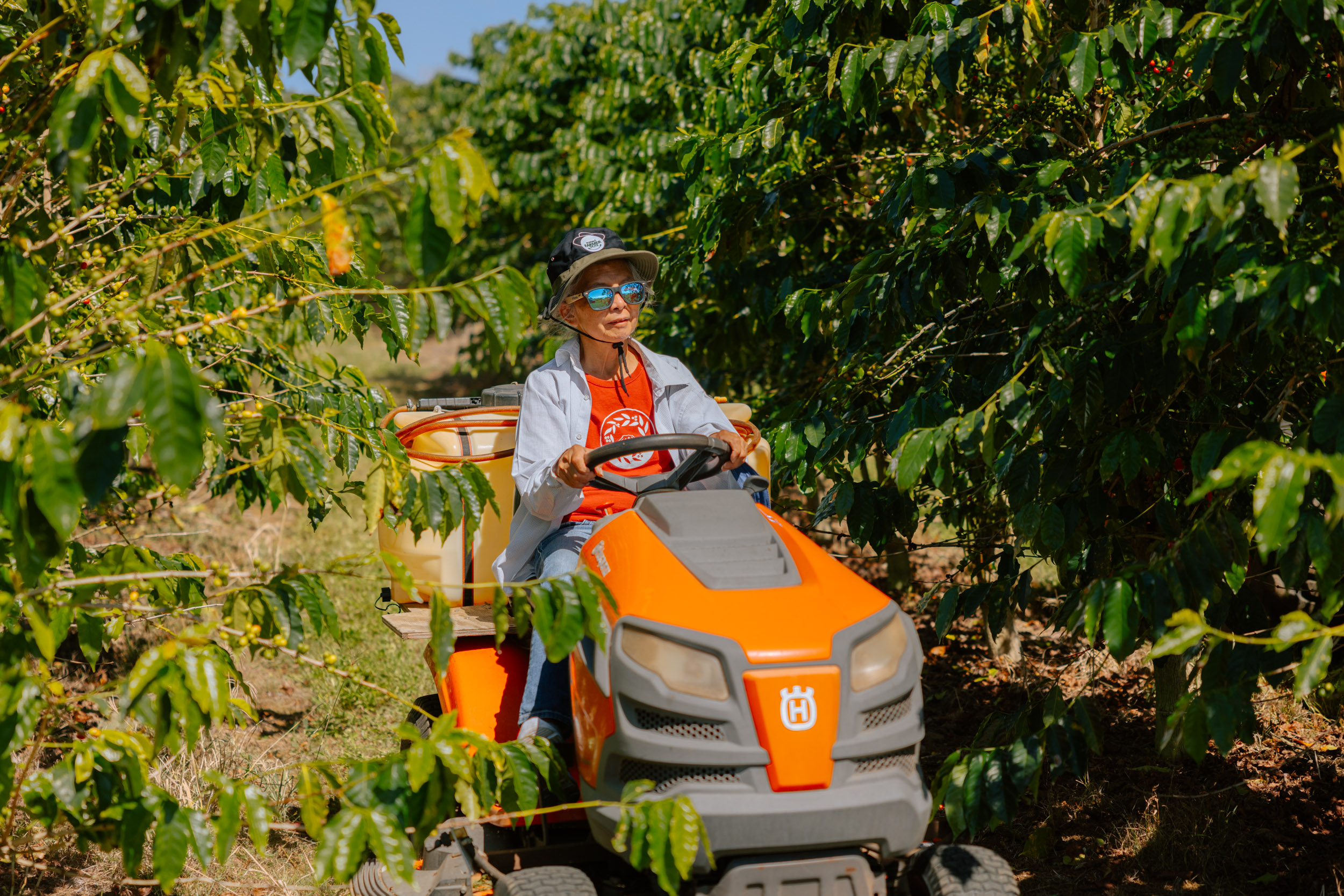
Our tractor and attachments, along with an irrigation system at the farm, have made the biggest difference. So has learning best practices for applying inputs from UH extension agents, USDA scientists, and scientists with the Hawaii Agriculture Research Center (HARC). We also receive updated training about pruning and other farming practices through our UH extension agents.
Q: Describe a specific challenge you faced and how you overcame it.
After my husband died, transitioning from two people working the farm, mill, and roastery to just one person was tough — especially when it came to the physical labor. Before my daughter and her husband moved to Hawaii, I received a lot of help from fellow Ka‘u farmers. They were very generous with knowledge and assistance. That’s how tight-knit the community is here.
Q: Has your state department of agriculture helped you advance your operation? How?
Yes, through HDOA equipment loans and operating loans, as well as its “Hawaii Seal of Quality” marketing program. We also participated in cover-crop research funded by a USDA Specialty Crop Block Grant that was administered by HDOA.