Press Release
ARLINGTON, Va. — This week, the National Association of State Departments of Agriculture and the National Agricultural Law Center announced the launch of Data on Economic and Bankruptcy Trends in Agriculture (DEBT), a data project that aims to provide a more comprehensive view of bankruptcy trends across the agricultural sector. The project compiles agricultural bankruptcy filings under both Chapter 11 and Chapter 12.
“A goal of our memorandum of understanding with the National Agricultural Law Center was to expand collaboration to inform agricultural policy and education,” NASDA CEO Ted McKinney said. “The DEBT project accomplishes exactly that by providing better data and a more complete picture of the economic conditions U.S. farmers are facing.”
“DEBT is a first step in gaining a definitive, foundational picture of agricultural bankruptcy filings in the U.S. from 2021 onward,” NALC Director Harrison Pittman said. “We look forward to collaborating with NASDA and others partners and stakeholders in building on this foundation.”
Historically, farms filing bankruptcies have been tracked through Chapter 12 filings, which is specifically designed for family farmers and family fishermen with regular annual income. It provides eligible farms with a process for reorganizing debt while continuing to operate.
However, agricultural businesses might file under Chapter 11, a broad business reorganization chapter, when they do not qualify for Chapter 12 because of circumstances like off-farm incomes. Like Chapter 12, Chapter 11 allows the farm to continue operating while developing a plan to restructure and repay its debts.
This project examined bankruptcy filings from January 2021 through June 2026. To find farms that filed under Chapter 11 rather than Chapter 12, NASDA and NALC worked with long-time NASDA partner SAS, an advanced analytics company that turns data into usable information. Utilizing Public Access to Court Electronic Records (PACER), an online system allowing access to federal court files, case dockets and legal documents, SAS developed an automated process to cross-reference that information with publicly available data from the USDA Farm Service Agency. When an entity appeared in a bankruptcy filing and as a USDA Farm Service Agency program recipient, SAS used that as an indicator that the entity was an agricultural operation.
Of the 1,401 agricultural bankruptcy filings mapped, 201 were filed under Chapter 11. All 1,200 filings under Chapter 12 were counted, as a requirement to file for Chapter 12 protection is that the filing entity must be a farmer or fisherman.
Because not all farms participate in USDA Farm Service Agency, the Chapter 11 results may not capture every agricultural operation that filed under that chapter. However, by compiling agricultural bankruptcy filings across both chapters, the DEBT project provides a more comprehensive view of trends across the agricultural sector.
The data can help identify changes over time, geographic patterns and emerging financial challenges affecting agricultural operations. These filings can offer a clearer picture of the financial realities facing U.S. agriculture for attorneys, policymakers, researchers, lenders and others seeking to understand and respond to those challenges. Learn more about the project, methodology and findings at https://nationalaglawcenter.org/debtproject/.

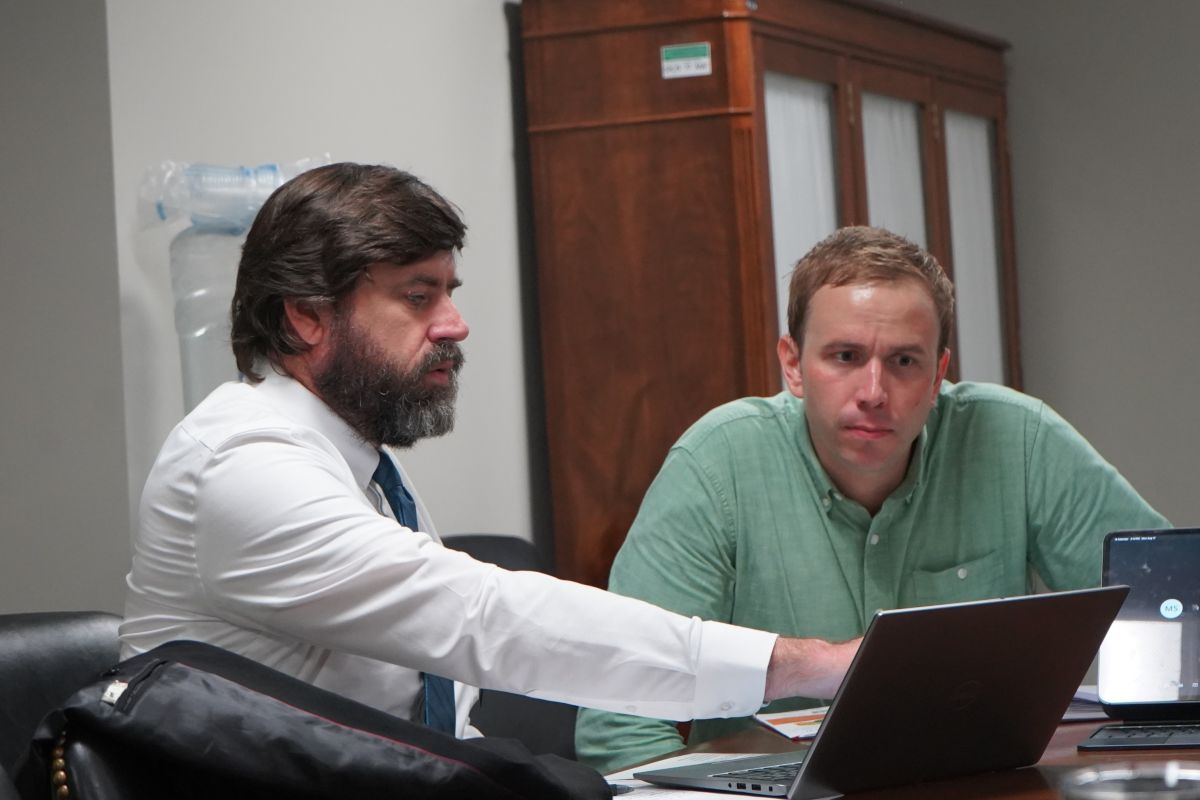
Left: NASDA CEO Ted McKinney shares about the project during a meeting with partners and stakeholders at NASDA’s Arlington, Virginia office. Right: NALC Director Harrison Pittman demonstrates the DEBT Project app during one of the meetings held this week with staff from the U.S. House and Senate Committees on Agriculture.
###
About the National Association of State Departments of Agriculture
NASDA is a nonpartisan, nonprofit association which represents the elected and appointed commissioners, secretaries and directors of the departments of agriculture in all 50 states and four U.S. territories. NASDA engages state departments of agriculture to strengthen U.S. agriculture and allied industries through policy, partnerships and public outreach. To learn more about NASDA, please visit www.nasda.org.
About the National Agricultural Law Center
Created by Congress in 1987, the National Agricultural Law Center serves as the nation’s leading source of agricultural and food law research and information. The NALC works with producers, agribusinesses, state and federal policymakers, lenders, Congressional staffers, attorneys, land grant universities, students, and many others to provide objective, nonpartisan agricultural and food law research and information to the nation’s agricultural community.
The NALC is a unit of the University of Arkansas System Division of Agriculture and works in close partnership with the USDA Agricultural Research Service, National Agricultural Library.
To learn more about ag and food research in Arkansas, visit aaes.uada.edu. Follow the Arkansas Agricultural Experiment Station on LinkedIn and sign up for our monthly newsletter, the Arkansas Agricultural Research Report. To learn more about the Division of Agriculture, visit uada.edu. To learn about extension programs in Arkansas, contact your local Cooperative Extension Service agent or visit uaex.uada.edu.